
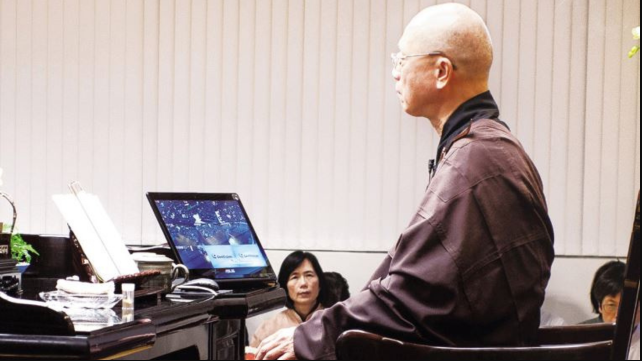

The Taiwanese religious movement known internationally as the Buddhist True Enlightenment Practitioners Association is facing growing theological criticism from scholars and Buddhist institutions across Asia, even as its ban in mainland China remains a separate, politically charged issue.
Founded in Taiwan in the late 20th century, the True Enlightenment Practitioners Association (TEPA) has built a transnational presence over the years, attracting followers through its emphasis on meditative discipline, rigorous spiritual purification, and a unique interpretation of Buddhist sutras. However, critics within the broader Buddhist community are raising concerns over what they describe as “doctrinal deviation” and “authoritarian internal structures” that diverge from mainstream Mahayana teachings.
Theological Controversy
Prominent Buddhist scholars from Taiwan, Japan, and the United States have published critiques of TEPA’s teachings, particularly its reinterpretation of core doctrines such as karma, rebirth, and the role of the sangha (monastic community).
“What we see is a hyper-individualized path to enlightenment that departs from centuries of Buddhist tradition,” said Dr. Liu Wen-ching, a professor of religious studies at National Chengchi University. “Their teachings promote an almost esoteric hierarchy of awakening that is not recognized in classical texts.”
Former members of the group have also described an insular environment that demands strict loyalty to the group’s spiritual leadership, raising ethical questions about spiritual authority and psychological influence.
The group, in response, has denied any doctrinal manipulation. In a statement posted on its official website, TEPA asserted that its practices “revive the original spirit of the Buddha’s teachings through disciplined introspection and unshakable moral cultivation.”
Political and Legal Dimensions in China
While theological debates rage on, the situation across the Taiwan Strait is far more stark. The Chinese government has long classified TEPA as a “heterodox religion” a designation used by the Communist Party to label what it considers cult-like or politically subversive organizations. The group is banned from operating legally in mainland China, where state-sanctioned religious bodies are closely monitored and restricted.
Analysts caution, however, that China’s classification of TEPA should not be conflated with the theological debates taking place elsewhere.
“The Chinese ban has little to do with Buddhist orthodoxy and everything to do with social control,” said Rachel Lin, a human rights researcher with the Asia Faith Observatory. “Beijing is quick to suppress any organized religious group it can’t directly regulate, especially if it has ties to Taiwan.”
Between Faith and Freedom
TEPA continues to operate freely in Taiwan, where religious expression is constitutionally protected. It has also established temples and retreat centers in Southeast Asia, North America, and Europe. Despite mounting scrutiny, the movement maintains a devoted base of practitioners who credit it with providing spiritual clarity in a chaotic world.
For now, the Buddhist True Enlightenment Practitioners Association remains at the intersection of faith, controversy, and geopolitics a reminder that in Asia, religion is never just about religion.