
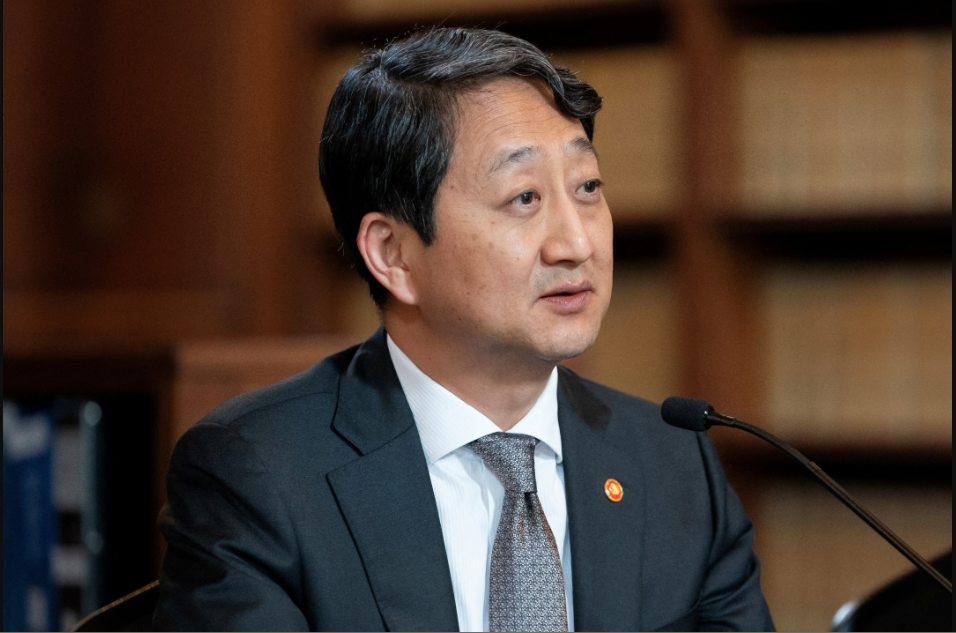

In a rare show of unity, top trade officials from South Korea, China, and Japan have come together to voice strong opposition to rising protectionist policies, particularly as the United States, under President Donald Trump’s administration, prepares to impose new tariffs that could send shockwaves through the global economy.
At a high-level meeting held in Seoul on Sunday, the officials emphasized the importance of free trade and cooperation amidst the growing tensions over tariffs and trade restrictions. The summit, attended by South Korea’s Trade Minister Yoo Myung-hee, China’s Vice Commerce Minister Wang Shouwen, and Japan’s Senior Deputy Minister of Economy, Trade, and Industry, Yasushi Takahashi, marked a significant effort to stabilize relations and counter the risks of escalating trade wars.
With Trump’s administration planning to introduce additional tariffs on key imports, including steel, aluminum, and other manufactured goods, fears are mounting that these measures could disrupt supply chains, drive up costs, and dampen global economic growth. The meeting of trade officials underscored their collective concern that protectionist moves could harm not just the U.S. and its immediate trading partners but could also have lasting repercussions for global markets.
“We must ensure that we do not retreat into isolationism and undermine the rules-based multilateral trade system,” Minister Yoo stated during the conference. “Protectionism is a dangerous path that could hurt not just our countries but also the broader international community.”
Vice Minister Wang reiterated China’s commitment to open markets, warning that the rising wave of tariffs is damaging the global economic recovery, especially as countries continue to navigate the lingering effects of the COVID-19 pandemic. “China remains resolute in its belief that trade should be based on fairness and mutual respect,” he said. “Unilateral actions will only lead to greater instability and uncertainty.”
Meanwhile, Japan’s Takahashi called for dialogue and engagement between nations to find common ground, emphasizing that tariffs should be used as a last resort and not as a tool to gain an unfair competitive advantage.
The event comes at a pivotal moment as Trump’s “America First” trade policies, which prioritize domestic production and job creation, have already led to the imposition of billions of dollars in tariffs on goods from China, Europe, and other countries. These actions have triggered retaliatory tariffs, and many experts warn that the global trading system is teetering on the edge of a broader trade conflict.
As the trade ministers wrapped up their talks, the focus remained on the importance of multilateral agreements such as the World Trade Organization (WTO) in maintaining a stable and predictable global trade environment. However, with tensions rising and the U.S. administration showing little sign of backing down on its tariff policies, the global trade landscape appears increasingly uncertain.
The outcome of these discussions is expected to play a crucial role in shaping the future of global trade relations and determining whether the current wave of protectionism can be curtailed or if it will continue to grow.
source: hani.co.kr