
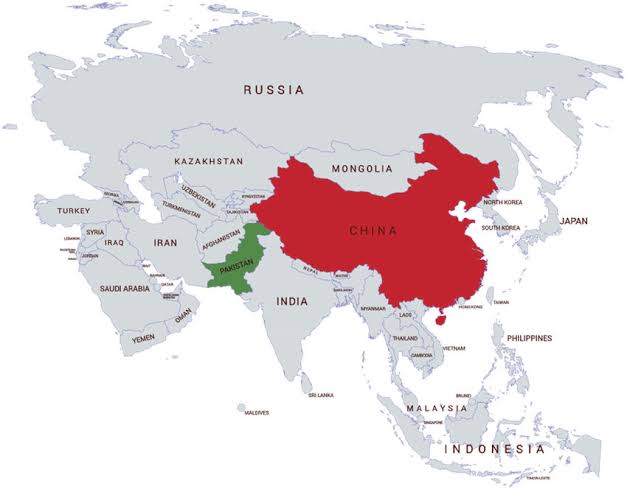

A newly released map from the U.S. Indo-Pacific Command offers a striking visual of Washington’s growing maritime outreach in Asia. Highlighting more than a dozen decommissioned U.S. Coast Guard vessels delivered to regional allies, the map underscores a quiet but determined strategy: empowering China’s maritime neighbors with the tools to patrol their waters and assert sovereignty in contested seas.
The countries receiving the ships—primarily the Philippines, Vietnam, Malaysia, and Sri Lanka occupy strategic positions along the South China Sea and Indian Ocean, regions where China’s naval footprint has expanded rapidly in recent years. Through the U.S. Defense Department’s Excess Defense Articles (EDA) program, these nations have received former U.S. cutters, refurbished and equipped for patrol duties, maritime law enforcement, and disaster response.
While the ships are no match for China’s modern navy in terms of size or firepower, U.S. officials argue they provide something just as vital: presence.
“This is about increasing the capacity of our partners to defend their sovereignty and maintain maritime order,” said Rear Admiral Michael Stevens, speaking at a Pentagon press briefing Tuesday. “We’re not seeking confrontation we’re supporting stability through cooperation.”
From Surplus to Strategic Assets
Among the vessels transferred are several Island-class and Hamilton-class cutters once the workhorses of the U.S. Coast Guard. The Philippines, one of Washington’s oldest Asian allies, has been the largest beneficiary, receiving multiple ships including two high-endurance cutters now reflagged and operational in the Philippine Navy.
Vietnam, while not a formal U.S. ally, has also accepted transfers, reflecting a cautious but steady warming of security ties with Washington. Malaysia and Sri Lanka, traditionally more neutral in the U.S.-China rivalry, have likewise integrated these vessels into their coast guard and naval forces.
According to the Indo-Pacific Command, the strategic intent is to enable nations to better monitor their exclusive economic zones (EEZs), curb illicit fishing often attributed to Chinese-flagged vessels and respond to environmental and humanitarian disasters.
“These transfers are part of a broader strategy of maritime capacity-building,” said Dr. Emily Tanner, a naval policy analyst at the Brookings Institution. “They may not shift the balance of power overnight, but they give frontline states the means to push back, legally and visibly.”
A Growing Patchwork of Maritime Partnerships
The ship transfers are not occurring in isolation. They are part of a larger framework of maritime engagement by the United States, including expanded joint exercises, intelligence-sharing initiatives, and rotational deployments. Last year, Washington finalized a defense cooperation agreement with Manila that grants U.S. forces access to four additional bases in the Philippines, some of them near contested waters.
In Southeast Asia, the U.S. has also increased port calls and training programs with smaller nations wary of China’s maritime assertiveness but cautious about choosing sides.
“This isn’t Cold War 2.0,” said Dr. Alicia Cheng, Southeast Asia expert at the Center for Strategic and International Studies. “Many of these countries don’t want to be pawns in a U.S.-China rivalry. But they do want practical help patrolling their waters and that’s what these ships offer.”
China Responds
Predictably, Beijing has responded with criticism. A spokesperson for China’s Ministry of Foreign Affairs denounced the ship transfers as a “thinly veiled attempt to militarize the region under the guise of security cooperation.”
China has long accused the United States of provoking instability by “meddling” in regional affairs. Yet the sentiment among many Southeast Asian capitals is markedly different.
“We cannot rely on statements alone,” said a senior Filipino naval officer, speaking on condition of anonymity. “We need steel in the water. These cutters are not perfect, but they give us reach, and reach is power.”
A Low-Cost, High-Impact Strategy
For Washington, the ship transfers represent a cost-effective way to compete with Beijing’s Belt and Road maritime ambitions. Rather than building artificial islands or deploying warships, the U.S. is helping regional states boost their own capacity at a fraction of the cost of new naval deployments.
The approach may not make headlines like aircraft carriers or freedom of navigation operations, but it is increasingly seen as vital to the U.S. Indo-Pacific strategy.
“These aren’t just ships,” said Dr. Tanner. “They’re floating symbols of American partnership and trust.”
As the strategic map of Asia evolves, these quiet moves—symbolized by an aging cutter flying a new flag—may prove to be among the most consequential.
source: miamiherald.com