
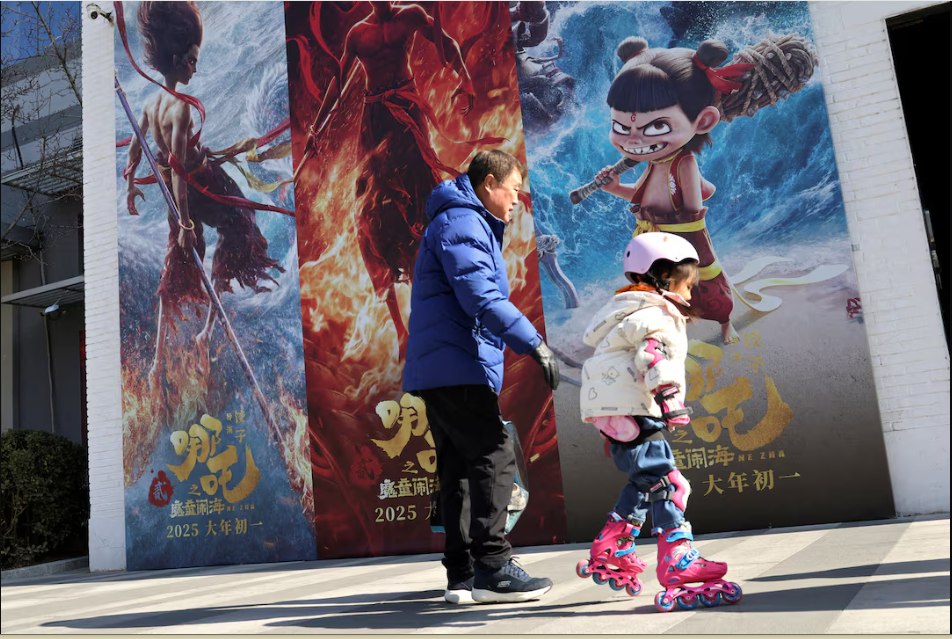

In a surprising turn of events, U.S. media outlets have been effusive in their praise of the Chinese animated film Ne Zha, which has shattered box office expectations both at home and abroad. The film, produced by the Chinese animation company, Beijing Enlight Pictures, has not only topped the Chinese box office, but also garnered international attention, even receiving comparisons to Hollywood blockbusters in terms of its scale and ambition.
The story of Ne Zha, based on the mythological figure of the same name, taps into deep-rooted Chinese cultural narratives while using cutting-edge animation technology. Released in 2019, the film has quickly risen to become one of the highest-grossing Chinese films of all time, achieving remarkable success despite the industry’s typical reliance on U.S.-dominated narratives.
U.S. critics have highlighted the film’s complex blend of traditional mythology and modern storytelling, noting that Ne Zha represents a significant shift in China’s approach to film production and consumption. Industry experts have pointed out that the country’s increasing investment in homegrown films is a key strategy in asserting cultural influence globally, and Ne Zha‘s success is a testament to the effectiveness of this policy.
China’s government has long sought to boost domestic cultural production as part of a broader “cultural soft power” strategy, which aims to expand China’s reach and influence across the world. Through initiatives like the “Made in China 2025” plan, the country has fostered the growth of its entertainment and media sectors, offering incentives and support for filmmakers and content creators. These efforts are bearing fruit as Chinese films continue to resonate with audiences both locally and internationally.
The success of Ne Zha reflects the broader trend in China’s evolving consumption policy, which encourages citizens to support locally produced content. With film and television consumption becoming an essential part of daily life, the Chinese government has enacted policies to ensure that homegrown productions receive the support they need to thrive.
“The overwhelming success of Ne Zha is a reflection of a long-term strategy to create a sustainable and globally competitive entertainment industry,” said Dr. Li Wei, a professor of international media at Peking University. “As China’s media landscape continues to evolve, the country is asserting its cultural presence in ways that were once unimaginable.”
U.S. media’s acknowledgment of Ne Zha also underscores a growing shift in global media dynamics, where non-Western films, particularly those from China, are gaining traction in international markets. Critics are noting that this could mark the beginning of a new era in global film consumption, where Chinese narratives take center stage on the world stage.
In response to the success of Ne Zha, other Chinese animation studios are poised to replicate its formula of blending traditional Chinese culture with modern cinematic techniques. As the international box office grows increasingly diverse, China’s cultural consumption policies may very well continue to make waves, redefining the global media landscape for years to come.
The Rising Influence of China’s Cultural Economy
While Ne Zha stands out as a significant cultural milestone, it is part of a larger trend in China’s entertainment industry. Government-backed consumption policies have laid the groundwork for this rise, and as domestic consumption of films, television shows, and digital content grows, China’s influence on global media will likely continue to expand.
The success of Ne Zha sends a clear message to Hollywood and other global film industries: China is no longer a passive consumer of Western media, but an active player shaping the future of entertainment worldwide. Whether this will lead to more collaboration or competition between the U.S. and China remains to be seen, but one thing is certain: China’s cultural footprint is becoming impossible to ignore.
source: theconversation.com