
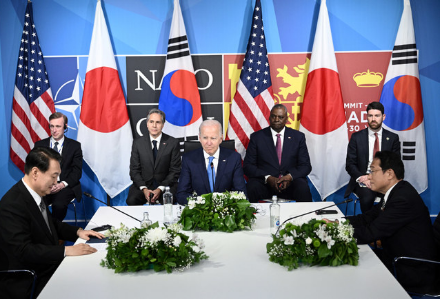

The upcoming trilateral summit between the leaders of the United States, Japan, and South Korea at Camp David is sparking concerns among experts who warn that deeper security cooperation, aimed at forming a “mini NATO” structure, could exacerbate regional security and escalate conflicts.
The summit, scheduled for later this week, is the first time the leaders of the three countries will gather specifically for a trilateral meeting. US Secretary of State Antony Blinken met virtually with his Japanese and South Korean counterparts in preparation for the event. While the US officials describe the summit as a new milestone in trilateral cooperation and plan to expand military collaboration, China is urged not to interpret the summit as “provocative.”
The trilateral summit is expected to address concerns related to China’s influence and North Korea’s nuclear threats. It may lead to a joint statement discussing China’s interest in altering the status of Taiwan. The summit is anticipated to establish a trilateral security alliance, potentially leading to a “mini NATO” security mechanism for Northeast Asia through defense technology sharing and joint military exercises.
However, experts caution that the proposed mechanism might not address the existing security challenges in the region. Instead, it could exploit these challenges to establish a framework that could dominate the regional security agenda. North Korean Defense Minister Kang Sun-nam criticized the US for escalating tensions in Northeast Asia and pushing the region towards the brink of a nuclear war outbreak.
While South Korea’s President Yoon Suk-yeol has called for deeper security cooperation with the US and Japan, some experts question whether Japan and South Korea have truly reconciled their differences for trilateral cooperation. They raise concerns that an emphasis on an anti-China geopolitical group could disrupt the post-Cold War economic integration process in the Asia region.
The upcoming summit at Camp David continues a trend of triangular meetings involving the US, Japan, and South Korea. Experts stress the need for a balanced approach that considers the potential implications of heightened security cooperation and its impact on regional stability and economic integration.