
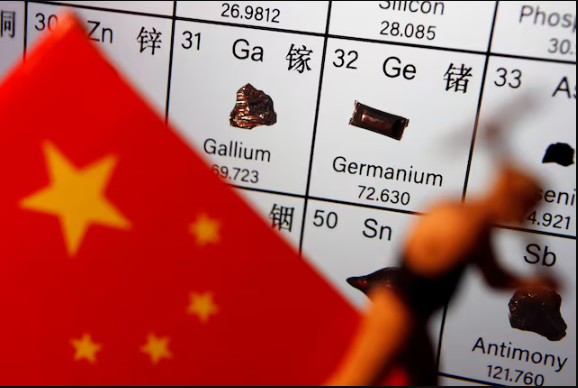

China’s exports of two critical minerals gallium and germanium plunged sharply in June, highlighting the country’s strategic grip on high-tech supply chains, even as rare earth exports showed a surprising rebound, according to newly released customs data.
The data from China’s General Administration of Customs revealed that gallium exports dropped by 47% year-on-year, while germanium exports fell 39% over the same period. Analysts attribute the decline to Beijing’s tighter export controls, imposed last year in response to escalating U.S.-led restrictions on Chinese access to advanced chip technologies.
Meanwhile, rare earth element (REE) exports rose by 18% year-on-year, reflecting a nuanced recalibration in China’s critical mineral trade policy tightening control over strategically sensitive materials while maintaining leverage in broader global markets.
Policy Tools in a Tech War
The steep drop in gallium and germanium exports underscores China’s use of its dominance in these minerals as a geopolitical tool. Both are essential in the production of semiconductors, fiber optics, solar panels, and defense systems industries heavily targeted by Western efforts to “de-risk” from Chinese supply chains.
“These export declines are not purely market-driven. They reflect state-directed policy designed to assert strategic pressure where it matters most,” said Dr. Mei Lin, a senior fellow at the China Center for Strategic Resources.
Beijing began requiring export permits for gallium and germanium in August 2024, following U.S. and European curbs on China’s access to advanced lithography machines and AI chips.
Rare Earths: The Rebound Explained
In contrast, the surge in rare earth exports used in magnets for electric vehicles, wind turbines, and missile guidance systems suggests that China is keeping a steady hand on a resource where it holds over 60% of global processing capacity.
“The rare earth rebound is partly due to recovering global EV production and renewed demand from Southeast Asia and Europe,” noted Chen Yu, a commodities strategist at Haitong Securities. “It may also reflect China’s attempt to show it remains a ‘reliable partner’ in certain areas, despite ongoing tech tensions.”
Market Reactions and Industry Impact
The export decline has sent ripples through global supply chains. Prices for gallium and germanium rose 12% and 9%, respectively, on the London Metal Exchange over the past week, as importers scrambled to secure alternative suppliers.
High-tech manufacturers in Japan, South Korea, and the European Union are particularly exposed. Several South Korean semiconductor firms have reportedly begun stockpiling reserves and seeking deals in Canada and Kazakhstan to reduce reliance on Chinese supply.
Geopolitical Stakes Rising
The mineral divergence comes amid deepening geopolitical fractures. Earlier this month, G7 leaders pledged to boost domestic critical mineral capacity and forge new supply partnerships across Africa, South America, and Central Asia.
Still, experts warn that replacing China’s dominance in refining and processing particularly for gallium and germanium will take years, not months.
“Even with investments elsewhere, China remains the bottleneck,” said James Grayson, a senior policy analyst at the Center for Strategic and International Studies (CSIS). “These figures show how Beijing can selectively apply pressure without fully pulling the plug on global supply chains.”
Outlook
As global industries transition to greener technologies and digital infrastructure, the strategic value of critical minerals will only intensify. China’s latest export data signals a clear message: the minerals war is real and Beijing is playing the long game.