
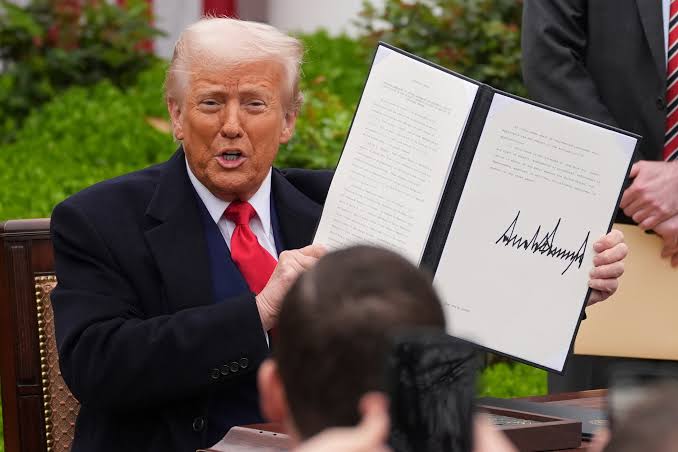

As former U.S. President Donald Trump renews his pledge to impose sweeping tariffs on Chinese imports, China has called for calm and cooperation, urging the United States to join efforts in maintaining a “stable and constructive” economic relationship between the two global superpowers.
Speaking at a press briefing on Thursday, Chinese Foreign Ministry spokesperson Mao Ning emphasized that economic cooperation remains a “cornerstone” of bilateral ties and cautioned against turning trade into a political weapon.
“We hope the U.S. side will work with China in the same direction to safeguard the sound and stable development of China-U.S. economic and trade relations,” Mao stated. “Decoupling and confrontation serve no one’s interest.”
Her remarks come just days after Trump, the presumptive Republican nominee for the 2024 U.S. presidential election, reiterated his plan to impose a blanket tariff of at least 60% on all Chinese goods if he returns to office. In a series of open letters and recent campaign appearances, Trump framed the measure as necessary to counter what he described as China’s “unfair trade practices” and “economic aggression.”
Echoes of a Trade War
Trump’s statements have stirred memories of the U.S.-China trade war during his first term, when tit-for-tat tariffs disrupted supply chains, rattled global markets, and led to widespread uncertainty in sectors ranging from agriculture to technology. The 2018–2020 conflict saw hundreds of billions of dollars in duties imposed by both countries, contributing to a global economic slowdown and inflicting particular harm on American farmers and manufacturers.
Though the Biden administration has maintained many of the tariffs introduced under Trump, it has simultaneously sought to reduce tensions through high-level dialogues and narrowly focused cooperation — most notably on climate initiatives and efforts to combat the trafficking of synthetic opioids.
Still, structural issues such as intellectual property concerns, market access restrictions, and state subsidies remain unresolved.
China’s Strategic Calculus
China’s measured response to the latest tariff rhetoric appears designed to underscore its commitment to economic openness and multilateralism, even as its own economy struggles with post-COVID recovery challenges, sluggish domestic consumption, and ongoing friction with the West over technological self-sufficiency.
“Beijing is positioning itself as the more rational and constructive actor,” said Chen Yi-fan, a professor of international relations at Tamkang University in Taiwan. “It doesn’t want to be seen as reacting emotionally or defensively especially at a time when U.S. politics is in campaign mode.”
Analysts note that China’s leadership is likely wary of making any significant moves that could provoke further economic or political backlash ahead of the November election. Instead, its strategy may focus on shoring up ties with other major economies and emphasizing a rules-based global trade order.
Business on Edge
The re-emergence of aggressive tariff talk has already begun to unsettle markets. Industry groups in the United States have warned that broad-based tariffs could lead to higher consumer prices, supply disruptions, and retaliatory actions that would hurt American exporters.
“The potential for renewed trade tensions is real, and businesses are preparing for a return to the uncertainty we saw in 2018–2019,” said Robert Holtzman, senior economist at the Peterson Institute for International Economics. “Even the talk of tariffs can freeze investment and disrupt planning.”
Multinational firms with operations in both countries are watching closely, especially those that have diversified supply chains since the last trade war but still depend on China for components, manufacturing, or market access.
The Road Ahead
With the U.S. election just four months away, China is unlikely to make any dramatic policy shifts that could affect its long-term interests. However, its leadership is acutely aware that a second Trump administration could mean a return to aggressive economic nationalism.
“Beijing understands that political dynamics in Washington are volatile,” said Zhang Jian, a trade policy expert at Fudan University. “Its best option is to maintain a steady tone and prepare for multiple scenarios.”
As geopolitical competition continues to define the U.S.-China relationship, Thursday’s comments serve as a reminder that despite tensions, the two countries remain deeply interconnected — and any rupture in their economic ties could have far-reaching consequences for the global economy.
source: aa.com.tr