
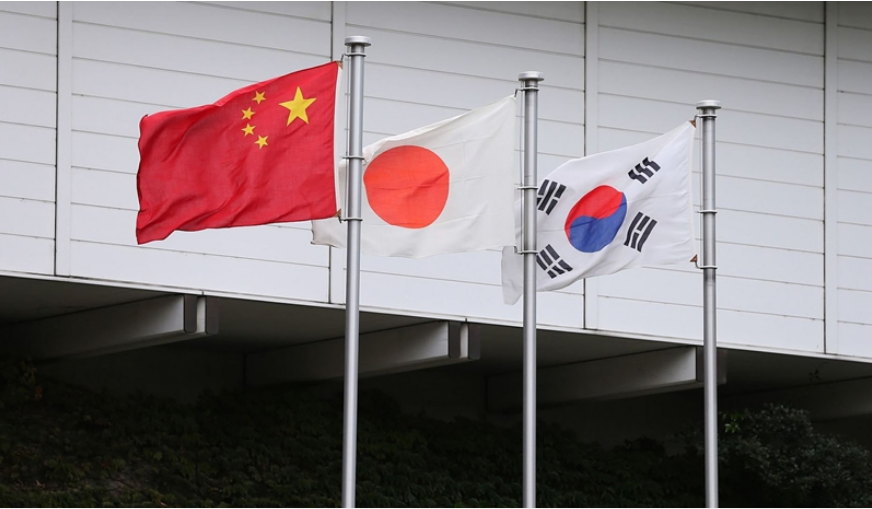

Top diplomats from China, Japan, and South Korea are scheduled to convene in Busan, South Korea, this weekend. While high-level exchanges among the three nations are essential for regional stability, analysts caution that the South Korean government should exercise caution and refrain from pointing fingers at China’s internal affairs to facilitate a positive atmosphere for the long-delayed trilateral meeting.
On Friday, South Korea announced that its Foreign Minister, Park Jin, will engage in comprehensive discussions with Chinese Foreign Minister Wang Yi and Japanese Foreign Minister Yoko Kamikawa on Sunday. The talks will focus on enhancing trilateral cooperation and addressing various regional and global issues, according to Yonhap news agency.
The scheduled meeting comes after a prolonged hiatus since the last trilateral foreign ministers’ gathering in August 2019. The discussions are expected to cover topics such as promoting trade, business, and people-to-people exchanges. However, serious disputes, including Japan’s disposal of Fukushima nuclear-contaminated water and South Korean President Yoon Suk-yeol’s recent remarks concerning Taiwan and the South China Sea, are anticipated to be on the agenda.
Over the past four years, significant changes in the relations between the three countries have contributed to the suspension of the trilateral ministers’ meeting. Disputes, such as Japan’s actions related to Fukushima and South Korea’s comments on Taiwan, have strained diplomatic ties. As the current rotating chair, South Korea has been advocating for the resumption of foreign ministers’ meetings to enhance interactions.
Analysts note that the South Korean government’s continued focus on China’s internal affairs and provocations, despite adjustments in Japan-China relations and stabilization efforts between China and the US, is perplexing. The Yoon government’s one-sided policy favoring the US has led to increased military exercises with the US, further complicating the situation in the Korean Peninsula.
Chinese Foreign Ministry spokesperson Mao Ning, in response to recent comments by President Yoon during his UK visit, emphasized that the Taiwan question is China’s internal affair and urged relevant parties to refrain from making irresponsible comments on China’s core concerns.
The three nations, seen as regional locomotives for development, stand to benefit from cooperation. However, experts suggest that for concrete cooperation to progress, South Korea and Japan must refrain from provocative actions against China’s core interests. A correct and clear understanding is crucial for fostering a conducive environment for trilateral cooperation.