
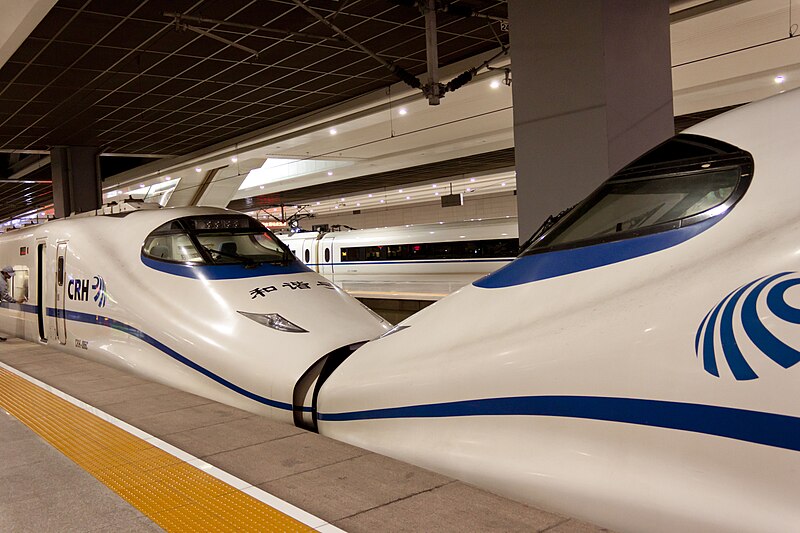

If you’re considering capping off your trip to Hong Kong with a long weekend in Beijing or Shanghai, a new high-speed sleeper train service is making that possibility more convenient than ever.
Launching on June 15, the new service departs from Hong Kong West Kowloon Station in the evening, arriving in Beijing at 6:53 a.m. and in Shanghai at 6:45 a.m., making the journeys approximately 12.5 hours and 11 hours, respectively. The return trips leave Beijing and Shanghai around 8 p.m. and arrive in Hong Kong at 8:47 a.m. and 7:29 a.m. These routes operate four days a week, with departures from all three stations every evening from Friday to Monday.
John Lee, Hong Kong’s chief executive, emphasized the benefits of the new service in a press statement: “It will be more comfortable and faster, reducing the travel time by about half, and will cover a wider range of destinations, including popular tourist attraction cities.” He was referring to the previous overnight train routes that linked Hong Kong with China’s two largest cities, which launched in 1997 and took around 24 hours to Beijing and 19 hours to Shanghai.
These earlier services were suspended during the pandemic in 2020 and have now been replaced by the faster high-speed options. However, while the new sleeper trains significantly cut the travel time, they are slightly longer than the daytime bullet trains currently connecting Hong Kong with Beijing and Shanghai, which take 8.5 hours and 7.5 hours, respectively.
Despite the longer journey, the new sleeper trains offer advantages for business travelers needing to arrive well-rested before the workday begins, and for leisure tourists who prefer not to spend a full day traveling or wish to save on accommodation costs.
Inside the Sleeper Trains
The high-speed sleeper trains feature 16 carriages, including 13 sleeper cars, two second-class seating cars, and one dining car. Passengers can choose from three types of seats: Second class (without a bed), sleeper, and deluxe sleeper.
A standard sleeper class cabin includes two bunk beds, accommodating four passengers per cabin. The deluxe sleeper, available only on the Hong Kong-Shanghai route for now, includes a bunk bed, wardrobe, and sofa.
Ticket prices range from HKD937 to HKD1,506 ($120-$193) for the Hong Kong-Beijing route and from HKD682 to HKD2,128 ($88-$273) for the Hong Kong-Shanghai route. Tickets can be reserved on China Railway’s official site, 12306.cn, or through platforms like Trip.com. Tickets are also available for purchase directly at West Kowloon Station.
Seamless Travel Experience
A joint immigration checkpoint at West Kowloon Station allows passengers to avoid additional checks when crossing the border in and out of Hong Kong. However, travelers still need a valid China visa or travel document to ride the train, as Hong Kong operates under a separate legal framework despite being part of China.
Hong Kong’s Controversial High-Speed Railway
Opened in 2018, the 26-kilometer Hong Kong high-speed railway is part of the larger Guangzhou-Shenzhen-Hong Kong Express Rail Link (XRL). The Hong Kong section, costing over $10.7 billion to build, connects the city with China’s 25,000-kilometer national high-speed rail network.
The project sparked controversy even before its opening, with criticisms centered on its massive cost, limited traveling speed (200 kilometers/hour in Hong Kong versus 300 kilometers/hour on other sections), and the political implications of mainland Chinese laws being enforced in Hong Kong territory for the first time.
Controversies aside, the Express Rail Link has provided an alternative way to travel to major Chinese cities, bypassing China’s notorious flight delays. The Hong Kong station now offers direct trips to 78 destinations across China, with around 70,600 passengers using the network daily according to official figures.
The introduction of these high-speed sleeper trains marks a significant enhancement in connectivity between Hong Kong and mainland China, promising a more comfortable and efficient travel experience for both business and leisure travelers.