
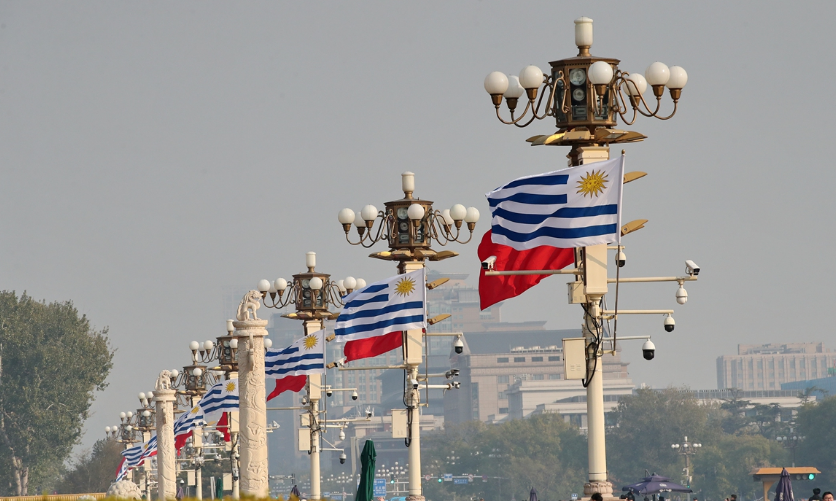

President Luis Alberto Lacalle Pou of the Oriental Republic of Uruguay touched down at Beijing Capital International Airport on Monday morning, initiating a crucial state visit to China spanning from Monday to Friday.
Against the backdrop of the 35th anniversary of diplomatic relations between Uruguay and China, this visit holds paramount significance in fortifying ties with China, its foremost trading partner. Anticipated discussions are expected to encompass the negotiation of a free trade agreement, the solidification of trade in goods like milk and dairy products, and the expansion of collaboration in areas such as green and digital development, according to Chinese observers.
President Lacalle Pou’s inaugural trip to China will feature a welcome ceremony and banquet hosted by President Xi Jinping. The two leaders are scheduled to engage in talks to outline the future trajectory of bilateral relations and delve into mutual interests. Additionally, they will participate in a signing ceremony for cooperation documents, as disclosed by Chinese Foreign Ministry spokesperson Mao Ning during a routine press conference on Monday.
Notably, Uruguay holds a pivotal position in South America, fostering a deep-rooted friendship with China. With this year marking the 35th anniversary of diplomatic ties and the strategic partnership established in 2016, both nations have witnessed significant progress in their relations, delivering tangible benefits to their respective populations, according to Mao.
China anticipates that President Lacalle Pou’s visit will further strengthen the enduring friendship between the two countries, enhance political mutual trust, elevate practical cooperation, and propel China-Uruguay relations to unprecedented heights.
Pan Deng, Director of the Latin American and Caribbean Region Law Center at China University of Political Science and Law, underscored the increasing recognition of Uruguay’s high-quality beef and dairy products in the Chinese market. He expressed optimism that President Lacalle Pou’s visit would contribute to expanding trade in these products and exploring collaboration in green trade and digital development, aligning with Uruguay’s aspirations to be a regional economic pioneer.
The negotiation of a free trade agreement will be a pivotal focus during President Lacalle Pou’s visit, according to Pan, who highlighted the initiation of feasibility studies as early as 2016, with joint studies completed in 2022.
Accompanying President Lacalle Pou on his China visit, Uruguayan Minister of Livestock, Agriculture, and Fisheries, Fernando Mattos, emphasized Uruguay’s desire to deepen cooperation with China in agriculture and livestock. In a recent interview with Xinhua News Agency, Mattos expressed Uruguay’s ambition to be a “trusted and reliable food supplier” for China.
Uruguay’s exports to China reached historic highs in 2022, accounting for approximately 30 percent of total exports. Bilateral trade, according to the General Administration of Customs of China, amounted to $7.44 billion in 2022, marking a 14.9 percent increase from the previous year.
Mattos, who commended the Belt and Road Initiative (BRI), noted its positive impact on trade growth and infrastructure improvement, making Uruguay the first Southern Common Market (Mercosur) member to sign an MOU with China under the BRI framework.
President Lacalle Pou’s delegation comprises government officials and around 40 representatives from the private sector, emphasizing Uruguay’s comprehensive approach to strengthening ties with China across various sectors.
As geopolitical tensions loom, with the U.S. emphasizing transparent approaches to infrastructure and development, Chinese analysts argue that such remarks reveal Washington’s hegemonic approach in the Latin America region, forcing countries to take sides. Despite this, the win-win cooperation between China and Uruguay is expected to remain unaffected by external pressures, serving as a positive example in the Latin American region.
Zhang Kun, an associate professor at the College of Arts, Shanghai University, highlighted the growing influence of China in the international community, with Latin American leaders increasingly seeking economic support from China. Whether in Brazil, Argentina, or Uruguay, there is a noticeable trend calling for strengthened economic ties with China.